

Quantum meets Semiconductors
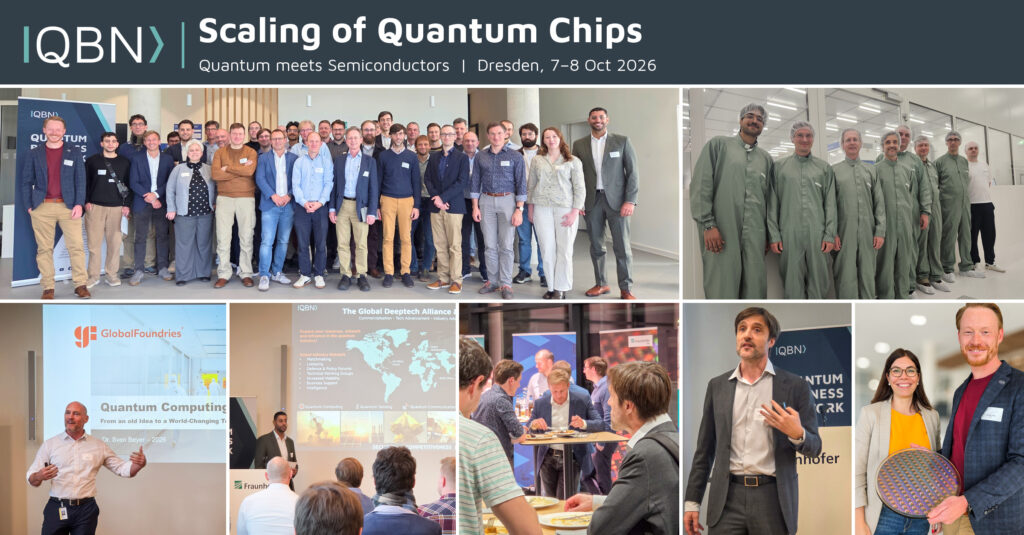
QBN brought quantum hardware developers, semiconductor specialists, equipment suppliers, researchers and policymakers together at Fraunhofer IPMS in Dresden on 7–8 October 2026. The Scaling of Quantum Chips workshop connected technical bottlenecks with the industrial conditions needed to overcome them. A recurring finding was that progress in individual devices must be matched by progress in manufacturing, testing, infrastructure and commercial deployment.
Scaling plans must cover the entire quantum computing system. Hardware and algorithm teams need to align their requirements through co-design. Packaging, control electronics and, where required, cryogenics must influence processor design and fabrication from the outset. These dependencies require developers to involve suppliers early. A processor that becomes more demanding to connect, cool or test can shift the scaling bottleneck into another part of the system.
The manufacturing goal must be consistent performance across larger numbers of processors and systems. A single “hero device” cannot demonstrate that. Developers and manufacturers must assess performance variation and the share of devices meeting requirements. Characterisation results must feed back into fabrication and system design, so the process improves the consistency of subsequent devices.
Testing must develop into a repeatable industrial process. Automated characterisation requires integrated measurement workflows. Hardware teams, test providers and, where needed, cryogenics specialists must coordinate equipment, measurement sequences and operating conditions. Test throughput must match planned production volumes. For cryogenic systems, cooling must support rapid measurement cycles during development and be expandable as operational systems grow.
The semiconductor industry is an important partner in addressing these challenges. Both communities must identify which established manufacturing and testing methods suit quantum requirements and where adaptation is necessary. Business leaders and engineers must work from the same assumptions about performance, cost and realistic production volumes. Manufacturing and business models must reflect these conditions; conventional semiconductor economies of scale cannot simply be assumed for quantum hardware.
Europe needs financing and infrastructure access that support the transition to industrial production. Funding bodies and investors must address the capital required between development and deployment. Infrastructure providers must establish practical access to the fabrication, design and testing capabilities companies need. Research organisations, suppliers and facility operators must coordinate existing strengths around concrete industrial requirements.
Customer demand must guide that development. Suppliers and industrial users need to define the performance, reliability and operating conditions an application requires, and assess usability and cost against the intended customer’s needs. A technically capable system must address a defined customer problem and be practical to operate.
QBN will continue this work through its Working Group Quantum Computing & Applications.
Get in touch with QBN to explore quantum opportunities for your business and connect with the right expertise and partners.
