

If anyone still thinks quantum technology is confined to academic labs, recent policy shifts should put that idea to rest for good. We are witnessing a fundamental shift in how global superpowers view the deep-tech supply chain. It is no longer just about research grants; it is about state-backed industrialisation, hardware sovereign control, and massive strategic capital.
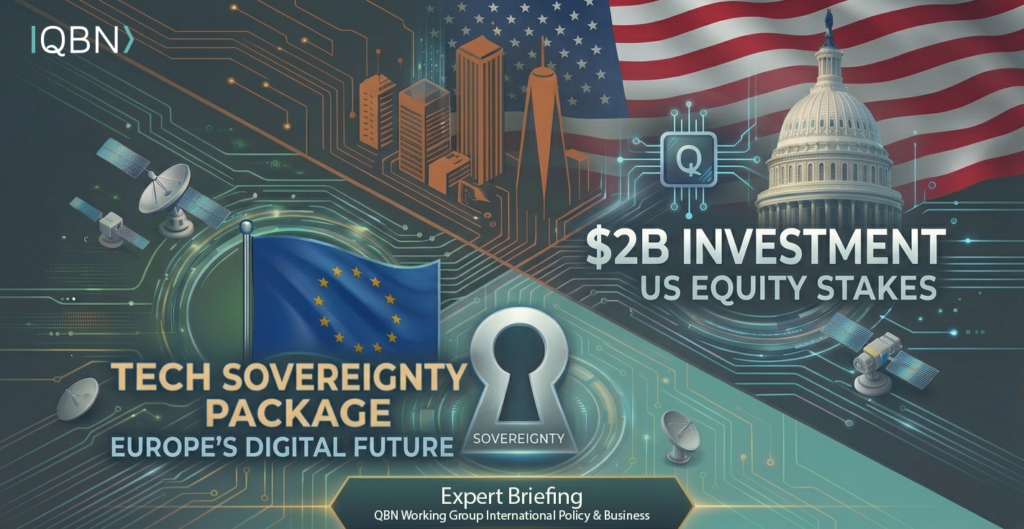
Last week, the QBN Working Group International Policy & Business (WG IPB) gathered for an exclusive expert briefing to unpack the deep industrial implications of two massive regulatory and financial moves redrawing our industry’s map: the recent $2B US Equity Investment Initiative in quantum computing and the newly unveiled European Technological Sovereignty Package.
Why These Shifts Matter for the Global Quantum Industry
The quantum ecosystem is hitting an industrial scaling phase, and governments are treating it as a matter of national security, economic resilience and geopolitical power.
- The US Approach: Moving beyond traditional grants, the US Department of Commerce’s landmark $2B funding plan under the CHIPS and Science Act marks a major shift toward direct federal equity stakes. By taking minority, non-controlling equity positions in nine key quantum firms, the Trump administration is actively building domestic manufacturing infrastructure, focusing heavily on critical hardware bottlenecks like dedicated foundries, cryo-CMOS, and advanced packaging.
- The European Response: On the other side of the Atlantic, the EU’s newly presented Tech Sovereignty Package, anchored by the Cloud & AI Development Act (CADA) and a highly anticipated Chips Act 2.0, seeks to aggressively build domestic infrastructure, scale up localised capacities, and codify strict sovereignty frameworks to reduce deep foreign dependencies – budgets and structures are still pending.
For deep-tech startups, scale-ups, and enterprise customers, these updates rewrite the rules of global fundraising, dual-use compliance, and international partnerships. Navigating this fragmentation requires a seat at the table where industry meets policy.
Behind the Discussion
The closed-door briefing brought together brilliant perspectives across the geopolitical landscape. We were joined by Carl Williams (CJW Quantum Consulting LLC), who provided deep context on the US strategy, and Georg Riekeles (European Policy Centre), who contributed a European perspective while Milja Kalliosaari (IQM) mapped out the complex landscape of Europe’s sovereignty ambitions. The session was expertly driven by our WG IPB Co-chair, Ulrich Mans (QuantWare).
Join the Conversation
Geopolitics and industrial policy are moving faster than ever, directly impacting market access and technology roadmaps. The QBN Working Group International Policy & Business is built exactly for this; it gives our members the clarity, early intelligence, and collaborative network needed to lead in a sovereign-conscious global economy.
Interested in shaping the future of global quantum policy and business? Get in touch to learn how you can participate in our next session.
More about QBN WG IPB: https://qbn.world/home/working-groups/wg-international-policy-business/
