

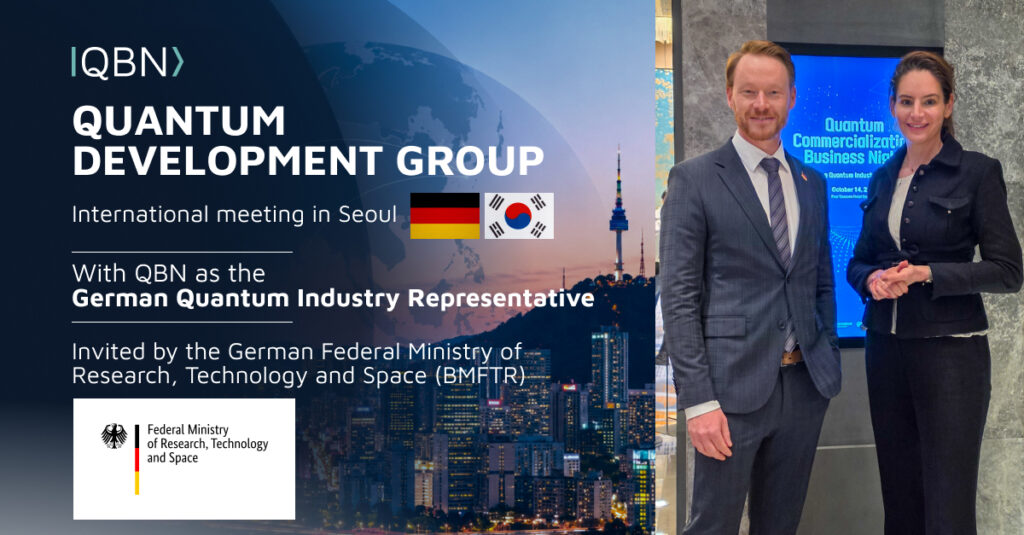
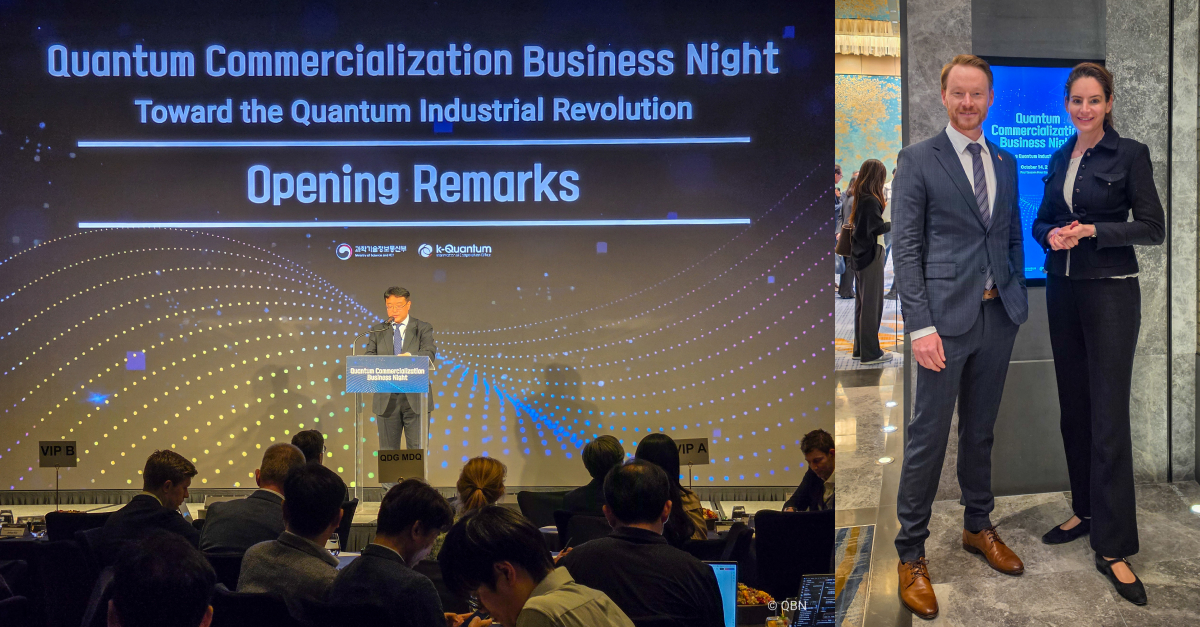
SEOUL, REPUBLIC OF KOREA / MUNICH, GERMANY – On invitation from the German Federal Ministry of Research, Technology and Space (BMFTR), Johannes Verst, CEO of Quantum Business Network (QBN), joined the German delegation at the Quantum Development Group (QDG) meeting in Seoul to represent the German quantum industry during the dedicated industry session.
The QDG is a multilateral initiative of 13 countries – bringing together the Republic of Korea, the United States, Britain, France, Germany, Japan, Australia, Denmark, Finland, Canada, Sweden, the Netherlands and Switzerland – promoting international cooperation on the responsible development and commercialisation of quantum technologies. Following the ministry-level sessions, QBN engaged in bilateral exchanges with international delegations as well as attendees at the subsequent Quantum Technology Business Forum.
Orchestrating Technology Push and Market Pull
While Germany and its global partners boast world-class research infrastructure and strong government backing, scaling deep-tech capabilities requires an active demand side. During discussions around commercial deployment and ecosystem cooperation, QBN highlighted the need to move beyond technical potential toward concrete business cases that deliver clear economic return for adoption partners.
“Germany’s industrial foundation in quantum, key enabling technologies and corporate end-users is exceptionally strong,” said Johannes Verst, CEO of QBN. “However, sustainable scaling will not happen through tech push alone. We must establish structured market demand across core sectors such as automotive, aerospace, chemical and defence. To achieve this, public policy must combine targeted funding for existing industrial strengths with clear economic and security objectives. We are deeply appreciative of the BMFTR’s continued trust and invitation to represent the German quantum ecosystem on this key multilateral platform. “
Furthermore, QBN emphasized that capital follows transparent demand markets. Unclear adoption pathways and fragmented export controls often deter private capital. By helping public and corporate buyers build structured procurement roadmaps, QBN enables high-tech suppliers to validate commercial demand and secure growth capital.
Countering Ecosystem Fragmentation Through Global Alliances
A central theme of QBN’s contributions in Seoul was the necessity of avoiding organisational and national fragmentation. Building redundant local capabilities or isolated national silos dilutes resources and slows down commercial progress. True technological sovereignty for Germany and Europe relies on access to distributed, trusted and interoperable allied supply chains across Europe, North America and Asia-Pacific.
QBN operates as an agile, overarching platform designed to connect regional industrial hubs directly to international markets and multilateral policy initiatives. By providing a trusted B2B platform, QBN enables high-tech SMEs, industrial scale-ups and corporate end-users to secure cross-border supply chains, access growth capital and drive real-world adoption.
About QBN
QBN is the global quantum alliance and B2B platform dedicated to advancing the quantum industry. Deeply rooted in Europe’s industrial core, QBN connects science, industry, investment and policy to accelerate commercialisation, industry adoption and scaling of quantum technologies.
Media Contact:
Email: info@qbn.world
Website: www.qbn.world
