

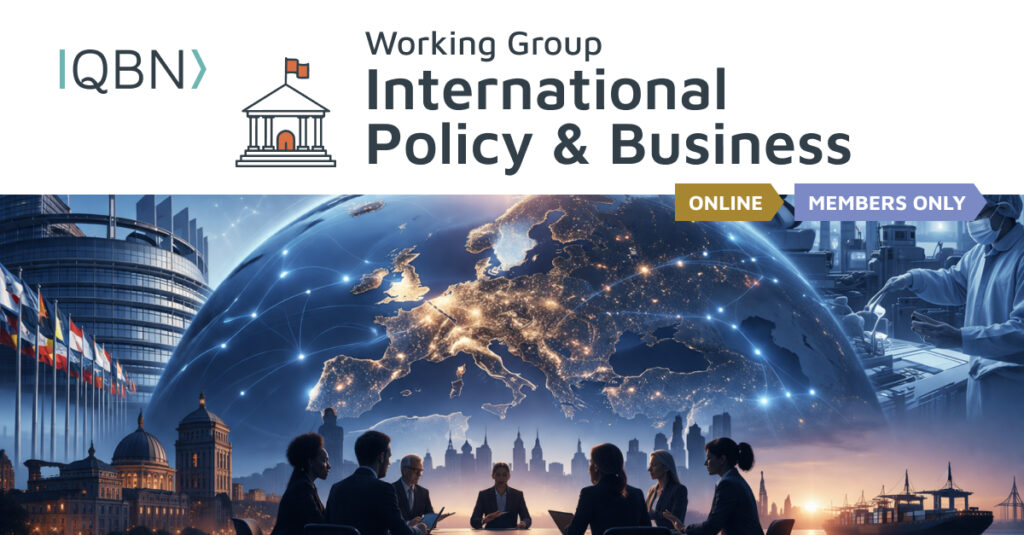
While we applaud the new emphasis on European sovereignty, the EU’s current strategic outlook on quantum is doomed to fail in the longer-term. Current policies are being designed to avoid overreliance on non-EU suppliers in various high-tech domains. This line of thinking has become a major focus for the EU and its member states. Protecting technology assets – such as quantum start-ups – from potential failure in a global market can be the right choice. As an overall strategy, however, Quantum Business Network (QBN) believes that the EU must not overprotect its quantum market from outside partnerships. How do we orchestrate a global quantum market while securing European competitiveness in the long-term?
The International Business & Policy Working Group, convened under the umbrella of the QBN, starts from this premise: Europe should not be a spectator in the quantum space race. It should deliberately build the industrial champions, joint infrastructures, and trusted value chains that make it a partner of choice—and a region that can defend its interests without asking others for permission
By providing a platform that combines policy intelligence, strategic dialogue, and international networking, the Working Group aims to support responsible international collaboration, and position Europe as a leading force in the emerging quantum economy. It also helps QBN members to operate successfully in a rapidly evolving global environment.
The Working Group will function as a member-driven forum that connects international policy discussions with the practical realities of scaling quantum companies and mature markets. Its objective is twofold: first, to help members anticipate and navigate policy developments that affect international market access, investment flows, and technology collaboration; and second, to catalyse new partnerships and opportunities that accelerate the commercialisation of quantum technologies.
Operating under the Chatham House Rule, the Working Group brings together senior representatives from industry, policy, and research who are prepared to speak frankly about risks, trade‑offs, and blind spots. The goal is not to produce yet another consensus paper, but to identify where alignment creates leverage—and where honest disagreement can sharpen strategies. Follow‑up actions can range from joint industry dialogues with policymakers and policy mapping exercises to targeted collaborative projects and structured international partnership formats.
The Working Group will focus in particular on areas driving demand-driven ecosystems where international policy developments intersect with business strategy, including export controls, investment screening, talent mobility, government procurement, supply chain resilience, and the evolving regulatory landscape for quantum technologies. Special attention will also be given to emerging European initiatives such as the EU Quantum Act and broader industrial policy frameworks affecting deep tech sectors.
Through this initiative, QBN aims to help ensure that the global quantum ecosystem evolves in a way that supports both technological progress and sustainable industrial growth and reflects European values, enables strong and fair partnerships, and anchors our security, liberty, and prosperity in technologies and value chains that we have created, own, control and can trust.
WG IPB Co-Chairs
Milja Kalliosaari, Government Relations Manager, IQM Quantum Computers
Tim Leonhardt, Vice President Business Development & Partner Management, eleQtron
Ulrich Mans
QBN invites industry leaders, policymakers, research organizations, and quantum innovators to engage with WG IPB to help shape a resilient global quantum ecosystem that reflects European values, fosters fair partnerships, and strengthens security, prosperity, and technological sovereignty.
Contact us to get involved: https://qbn.world/home/contact/
Learn more about WG International Policy & Business
