

This briefing outlines the key facts, motivation, adoption timeline, current legislative status, and direct impacts of the European Innovation Act for stakeholders across the quantum industry, deeptech community, and dual-use sector.
Executive Summary, Motivation & Strategic Alignment
The central objective of the European Innovation Act is to resolve Europe’s persistent commercialisation deficit, transforming world-class scientific research and deeptech excellence into industrial market strength and domestic economic value creation while preventing European startups and SMEs from migrating abroad to scale. By tackling structural impediments such as fragmented public procurement markets and the historical inability to leverage intellectual property as financial collateral, the framework directly addresses European technological sovereignty, dual-use capabilities, and the retention of homegrown deeptech champions.
Formally adopted by the European Commission on 9 September 2026, the European Innovation Act constitutes a foundational legislative pillar of the EU Startup and Scaleup Strategy and the broader Competitiveness Compass. It has been transmitted to the European Parliament and the Council of the European Union for negotiation and amendment.
1. Key Facts
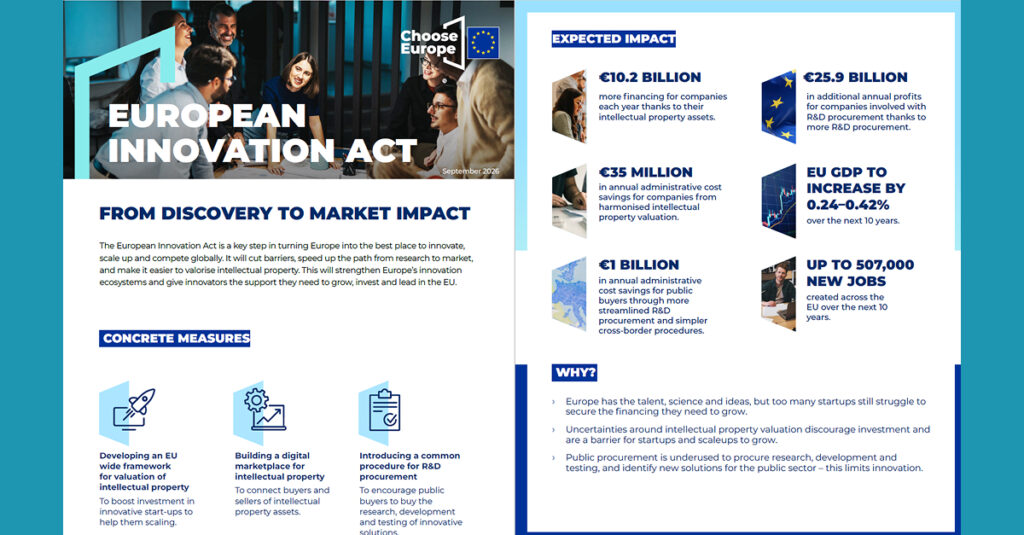
Concrete Measures
| Pillar / Mechanism | Key Focus | Objective
|
| IP Valuation & Financing | Harmonised EU-wide IP valuation frameworks, digital IP marketplace and competence support. | Unlock IP-backed venture capital and debt financing for capital-intensive deeptech assets. |
| R&D Public Procurement | Streamlined and harmonised framework for public procurement of R&D services across member states. | Reduce market fragmentation, provide legal clarity and accelerate market entry for breakthrough solutions. |
| Regulatory Sandboxes | Parallel proposal for a Council Recommendation establishing common principles for regulatory sandboxes. | Enable innovators to test advanced technologies under controlled regulatory oversight. |
Expected Impact by the European Commission
For companies
- €10.2bn additional annual financing through their IP assets.
- €25.9bn additional annual profits through more R&D procurement.
- €35m annual administrative cost savings via harmonised IP valuation.
For public buyers
- €1bn in annual administrative cost savings through streamlined R&D procurement and simplified cross-border procedures.
For the European Union
- 24% to 0.42% projected increase in GDP over the next 10 years.
- Up to 507,000 new jobs created over the next decade.
2. Current Legislative Status
Following its adoption by the European Commission on 9 September 2026, the legislative proposal has officially entered the ordinary legislative procedure, advancing to the European Parliament and the Council of the European Union for formal negotiation and amendment.
- Expected Amendment & Adoption: Given typical EU ordinary legislative cycles for major competitiveness files, final political agreement and formal adoption of the regulation by the European Parliament and Council are expected between late 2027 and mid-2028.
- Real Market Impact: Following a standard transition and transposition period for member states and EU bodies, tangible commercial and structural impacts, such as standardized IP-backed lending, digital marketplace operations and harmonised R&D procurement frameworks, are anticipated to materialize on the ground starting in 2029–2030.
3. Context: Why the Framework is Long Overdue
The introduction of the European Innovation Act comes in response to structural bottlenecks that have long hindered Europe’s deeptech and dual-use landscape from matching its research output with commercial scale:
- While Europe possesses a strong scientific base and prominent research capabilities in fields like quantum technologies and deeptech, market observers note that translating this research into global commercial leaders remains a persistent structural challenge.
- Fragmented public procurement frameworks and difficulties in utilizing intangible assets as collateral severely restrict early-stage growth and private capital mobilization.
- Shifting geopolitical dynamics heighten the operational necessity for robust European technological sovereignty, resilient infrastructure and dependable dual-use industrial capabilities.
Ultimately, addressing these long-standing systemic hurdles is long overdue to prevent further erosion of Europe’s industrial base and to ensure homegrown innovators can compete globally without leaving the EU.
4. Potential Impact for the Quantum, Deeptech & Dual-Use Sector
For technology suppliers, industrial buyers, and institutional stakeholders across the quantum, deeptech and dual-use ecosystems, the proposed regulation introduces structural shifts that hold significant potential for future operations and commercial growth:
- Enhanced Capital Mobilisation: Standardised intangible asset and IP valuation methodologies hold the potential to establish the necessary mechanisms for capital-intensive hardware and software ventures to secure institutional debt and equity financing.
- Streamlined Dual-Use Engagement: Harmonised R&D procurement rules promise to shorten sales cycles and establish predictable pathways for deeptech and quantum companies to engage with public sector and defence procurement agencies.
- Controlled Regulatory Testing: Sandbox environments offer structured pathways to navigate complex regulatory requirements, holding the potential to enable rapid testing and deployment of sensitive technologies.
- Retention of Industrial Scaleups: By establishing domestic conditions that support scaling and commercialisation, the regulation holds the potential to ensure European deeptech and quantum companies remain anchored within the European ecosystem.
What Suppliers and Industrial Buyers Can Do Now
To prepare for these upcoming structural changes and proactively influence the legislative rollout, market participants should consider the following strategic measures:
- Engage in the Legislative Process: Industry associations, corporate actors, and startup alliances should actively feed practical implementation insights into ongoing European Parliament and Council discussions, particularly regarding IP valuation standards and defence/dual-use procurement criteria.
- Audit Intangible Assets: Deeptech suppliers should review their current intellectual property portfolios and valuation practices to prepare for upcoming standardized frameworks and digital marketplaces.
- Prepare for R&D Procurement Shifts: Public and private buyers should begin evaluating how upcoming harmonization rules can be integrated into future technology roadmaps, particularly for pre-commercial procurement and innovation partnerships.
Conclusion & Next Steps with QBN
As the European regulatory landscape shifts toward implementation, turning deeptech and quantum research into economic value requires active, cross-sector and collaborative action across all stakeholders. QBN is actively engaging with policymakers, industrial leaders and public bodies to help build the commercial foundation for Europe’s deeptech champions. To connect with our initiatives, working groups and collaborative ecosystem, visit the QBN.
Official Resources:
Downloads
Become a QBN member and log in to view and download further Resources!
- Factsheet: From Discovery to Market Impact
- Proposal for the European Innovation Act
- Impact Assessment Report
- Executive Summary of the Impact Assessment Report
