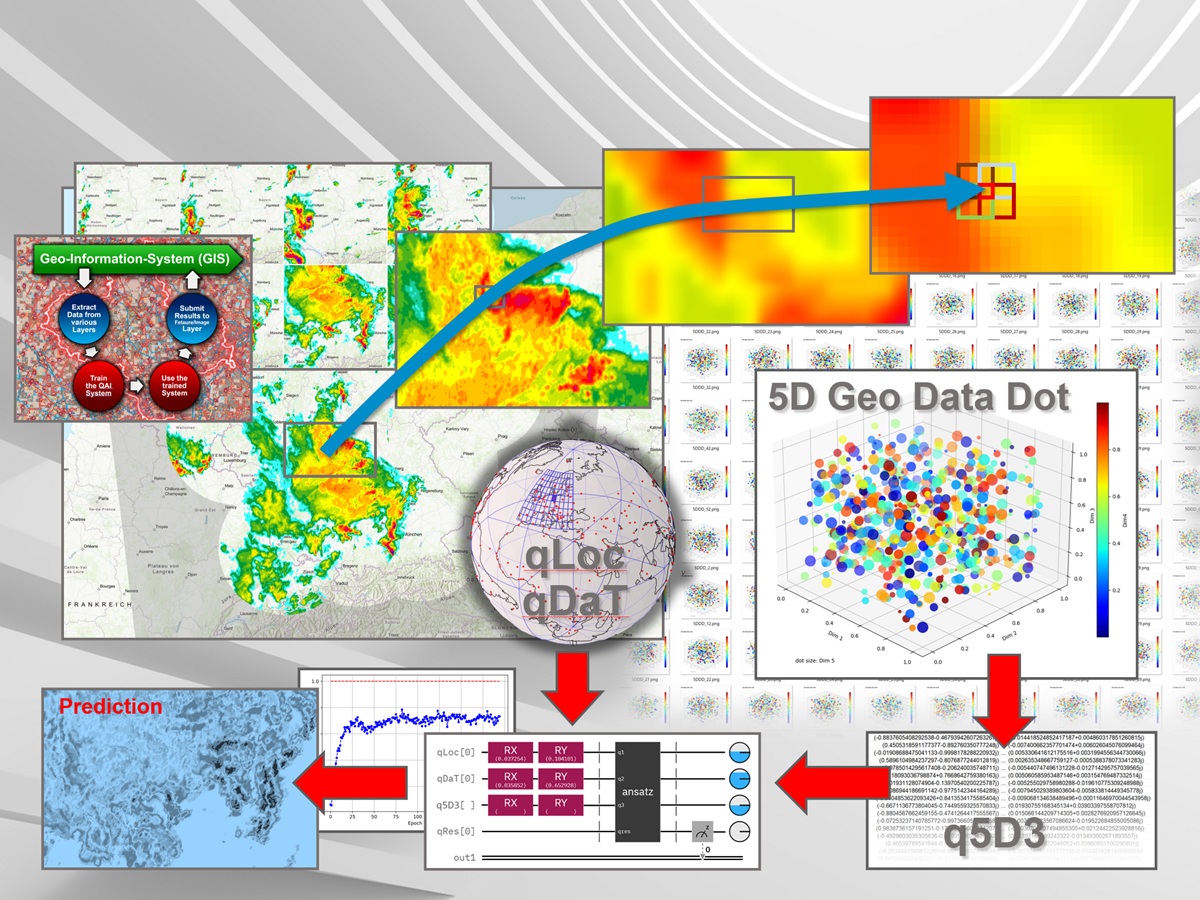
Business, science and administration, but also politics and society are increasingly relying on the analysis of spatial- and datetime-referenced data to reveal hidden patterns in existing information visible, to gain new insights and to stay one step ahead of the competition. Comprehensive knowledge of existing conditions and values is an essential basis for planning, reorientation and utilization processes.Quantum Computing is the next big thing in information technology. Combined with Geographic Information Systems tools it will enable a wide range of further advances in spatial analysis. Based on the phenomena of quantum mechanics, superposition and entanglement, and the associated high performance of quantum computers, artificial intelligence can be operated more efficiently on quantum hardware than on classical computers.
The technical basis of the GIS used here includes connectors for layers of information from above, at, and below the Earth’s surface. This allows to extract and connect data from various layers into Geo Data Dots and use them to train the QAI system. With the trained system predictions are made. Finally, the results are retransformed and submitted to the GIS.
The system is up and running, and it’s working well.
In the next steps the algorithm is to be adjusted to run on other quantum hardware. At the same time the structure of the circuits, the presentation of data for the quantum hardware, and the entire data workflow will be optimized.