

SemiQon is launching a next-generation quantum chip enabling scalable quantum computing, supported by scalable cryo-optimized manufacturing in new facilities.
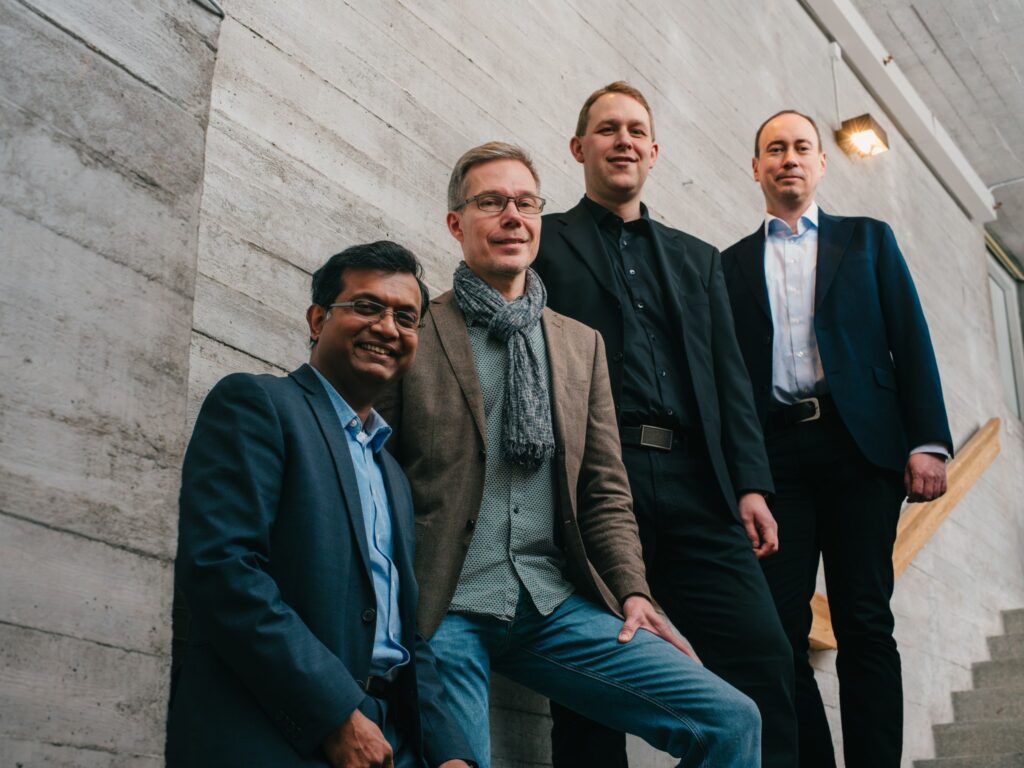
SemiQon celebrated its three-year journey together with the Finnish quantum community on February 12. In just three years, the company has grown from a four-founder team into a 30-employee startup preparing for its next stage of growth and the launch of a next-generation quantum chip.
“Our journey from a VTT spin-off to where we are today has been made possible by the strong support from the community. In the next phase, the importance of that community will only grow — and that community is what today is all about,” said SemiQon CEO Himadri Majumdar in his opening remarks.
Scaling manufacturing in Kvanttinova
As part of this new growth phase, SemiQon will relocate to Kvanttinova, which is to be constructed in Otaniemi, Espoo. Compared to its predecessor Micronova, Kvanttinova will offer three times the manufacturing capacity.
“Kvanttinova strengthens SemiQon’s ability to transition from breakthrough R&D to products. It provides seamless access to Micronova, pilot lines, and the broader Otaniemi ecosystem to accelerate scalable cryo-electronics fabrication”, said SemiQon founder and COO Markku Kainlauri during the event.
Micronova community has played a central role in the company’s early development.
“It has been a truly transformative environment for developing both product and manufacturing technologies. We’ve been able to achieve an extremely fast development and iteration cycle from design to fabrication and testing,” said SemiQon founder and Chief Research Officer Professor Mika Prunnila in his keynote address.
Launching new generation quantum hardware
SemiQon is the first company in the world to develop a silicon-based chip capable of operating in cryogenic conditions with extremely low power consumption — a key requirement for scaling quantum computing systems.
The technology enables data processing to occur close to qubits — the fundamental computational units of quantum computers — without proportionally increasing heat load through thermal connections between cryogenic and room-temperature environments.
In current architectures, classical processing typically takes place at room temperature, creating scalability bottlenecks.
SemiQon’s approach helps shift quantum computing from a research-driven challenge toward an engineering and manufacturing challenge.
“This year, we will release our first chip that enables quantum computer manufacturers to scale input/output capacity while significantly reducing energy consumption,” said SemiQon founder and CTO Janne Lehtinen.
Expanding opportunities beyond quantum computing
In addition to quantum computing, cryogenic semiconductor electronics are opening new opportunities in fields that require reliable computing in extremely cold environments.
Interest in SemiQon’s chip technology is growing in sectors such as space technology and defense, where cryogenic operation can be a system-level advantage.
Still, the long-term trajectory of quantum technology remains difficult to predict.
“Predicting the technological future is always difficult,” said Prunnila.
“In 1977, the CEO of Digital Equipment Corporation estimated that no one would ever want a computer in their home. Just a few years later, Commodore 64 sold tens of million units. Hindsight is always easier than foresight.”
Commercializing deep technology
Alongside the reflections on SemiQon’s progress and future, the anniversary event brought together leading industry experts for discussions on product development and the commercialization of deep technologies, highlighting the importance of long-term collaboration in transforming scientific breakthroughs into scalable products and businesses.
During a fireside discussion, Bluefors Chief Business Development Officer & Principal Scientist David Gunnarsson emphasized that quality ultimately determines commercial success in deep technology.
“We started 18 years ago with modest business goals. Our aim was to make cryogenics accessible to the research community. We set out to deliver high-quality, reliable equipment purely for scientific use.”
Bluefors eventually grew into the world’s leading manufacturer of cryogenic systems, despite early-stage investors initially turning their backs on the company.
“Quality ultimately led to a growing market, and thanks to their reliability, our systems have today become enabling standard products for quantum computing,” Gunnarsson said.
How does a deep-tech startup balance revenue growth with continued investment in research and development?
“You can’t focus on just one, but you also can’t assume you’ll remain competitive three years from now without continuing to invest heavily in improving your product,” said Joonas Govenius, founder and CEO of Arctic Instruments.
The importance of community
In a panel discussion, moderated by entrepreneur and editor-in-chief Harri Junttila, SemiQon Chair of the Board Antti Vasara, Vice President of Strategic Marketing at Murata Electronics Tomy Runne, and InstituteQ Development Manager Pauliina Rajala discussed how the commercialization of quantum technologies can be enabled.
The importance of community was a recurring theme.
Runne encouraged the quantum sector to follow the example of Finland’s semiconductor ecosystem, where research led to globally significant businesses — first Vaisala, and later companies such as Murata Electronics and Okmetic.
“In Finland, it’s worth asking for help — asking whether something can be done. At Murata, for example, we approached VTT directly to ask whether certain components could be manufactured and how it could be done. They answered yes, and that helped Murata Electronics move forward,” Runne said.
“The challenge may lie more on the risk-taking side. Private capital in Europe needs the courage to invest earlier, when valuation levels are still moderate. It is not particularly strong investing to join only after company valuations have already soared,” Antti Vasara noted.
“Finland’s national quantum technology strategy is an ambitious vision for the coming decade. Implementing it will be possible only through cooperation in Finland and across Europe”, said InstituteQ Development Manager Pauliina Rajala.
