

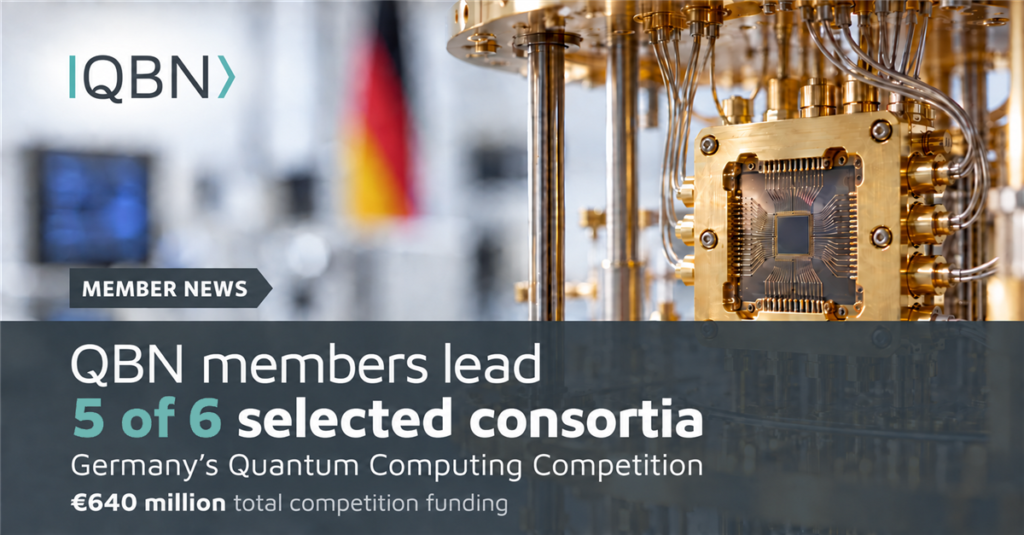
Five of the six consortia selected to apply for funding under Germany’s Quantum Computing Competition are led by QBN members: planqc, QUDORA Technologies, neQxt together with Fraunhofer IIS, IQM, and Peak Quantum.
The consortia can apply for a share of €640 million for hardware development and pilot production lines. The Federal Ministry of Research, Technology and Space aims to make at least two quantum computers with error correction available to industrial users by 2030. The selection marks the next stage in the application process.
The competition covers neutral atoms, trapped ions and superconducting qubits, with support extending to processors, control systems and error correction. Investment in pilot production is intended to help teams build larger systems under consistent manufacturing conditions.
Germany hopes to close the gap with the US and China. Potential industrial applications include drug development, materials science, chemistry and energy systems, as well as traffic management and supply chain optimisation. Reducing the errors that still limit today’s hardware will be essential to making these applications viable.
The emphasis on pilot production also connects with QBN’s earlier policy work. In its January statement on the Hightech Agenda Deutschland, QBN called for pilot facilities to be closely linked to industrial production and customer needs. Its July response to the Quantum Technologies Roadmap welcomed the focus on technology transfer and pilot lines, while calling for faster funding procedures, stronger supply chains and public procurement to help quantum companies reach customers.
Congratulations to our members and their consortium partners on their selection.
