

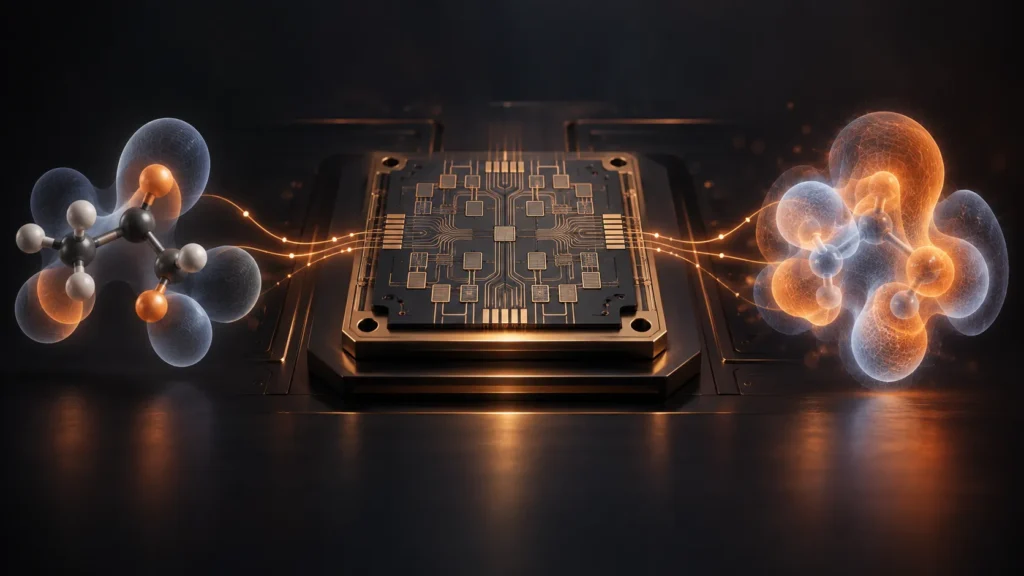
Landsberg am Lech, Germany – 2026-09-25 – data cybernetics ssc GmbH, the company behind the quantum state preparation platform Q-Alchemy, has run a full chain of molecular quantum-state experiments on real IBM quantum hardware. The team started from classically computed molecular wavefunctions, turned them into compact preparation circuits, ran them on a physical quantum processor, and reconstructed the resulting states from measurements. They did this for twelve molecular systems, using between 4 and 72 qubits.
Loading data into a quantum computer is one of the field’s most persistent bottlenecks. A molecular description that is manageable on paper can need a very long sequence of operations to prepare on hardware. Once the state is prepared, it cannot simply be read back. Measurements return only partial information, so the preparation has to be repeated thousands of times. data cybernetics took on the whole problem at once: making the state, running it on hardware, and rebuilding a result that can be checked against the original.
Key results
- The full pipeline ran on real hardware at every scale attempted. All twelve systems completed the journey on an IBM device with 120 qubits. The campaign took about six and a half hours, and every submitted job returned data.
- Several reconstructions closely matched their reference states. Fidelity is a similarity score from 0 to 1, where 1 is a perfect match. The results were hydrogen 0.986, lithium hydride 0.964, beryllium hydride 0.949, molecular oxygen 0.929, and nitrogen 0.895. Oxygen and nitrogen ran as 20-qubit circuits on physical superconducting qubits.
- Fast classical circuit generation at scale. For the largest system, dichromium (Cr₂, 72 qubits), the reference state had 54,167 non-zero entries. Q-Alchemy’s QTucker method generated its preparation circuit in about 53 seconds on a conventional computer. Before hardware noise, the circuit reached a calculated fidelity of about 0.88.
- Open reporting of limits. The 72-qubit dichromium run executed completely, including 14,351 measured properties, but the final reconstruction failed. The team traced part of this to a reconstruction model that was too compact to describe the state. This gives a concrete target for the next round of work
The technologyy
The experiment is built on QTucker, data cybernetics’ method for finding structure in quantum states. QTucker uses this structure to build compact preparation circuits and low-rank reconstruction models. The method is described in a research paper and a peer-reviewed book chapter. At no point does the pipeline build a full dense state vector. For 72 qubits, that would mean roughly 4.7 × 10²¹ complex amplitudes. Instead, it works with sparse and low-rank representations throughout.
Because the hardware measurements are stored, they can be reused. The team can try better reconstruction methods in software without repeating the expensive hardware runs.
“Having a description of a molecule on your laptop does not mean you can simply upload it into a quantum computer,” said Carsten Blank, CEO, data cybernetics. “With this campaign, we have made the whole chain run on real hardware: from a molecular description, to a state prepared on a quantum processor, to a reconstructed result we can evaluate. Several molecules came back as close matches, and the hard cases show us exactly where to improve. We now have a complete testbed for making preparation shorter and reconstruction smarter.”
Context and next steps
data cybernetics presents the results as an engineering milestone, not a claim of quantum advantage in chemistry. The fidelities compare reconstructed states with approximate reference models. Showing usefulness for chemistry will require checking task-specific properties, such as energies. Next, the team plans to repeat the campaign to measure consistency and to compare the hardware results with controlled simulations. The results also suggest that shorter circuits give better outcomes, so the team will pursue shorter circuits and more flexible reconstruction models.
The work was funded by the German Federal Ministry of Research, Technology, and Space (BMFTR) under grant 13N17157 (QROM), and the hardware experiments used quantum credits from the IBM Quantum Startup Program.
Read more:
Blog post: From Molecular Data to Real Quantum Hardware and Back
Technical account with full results for all twelve molecules: q-alchemy.com/solutions/quantum-chemistry
