

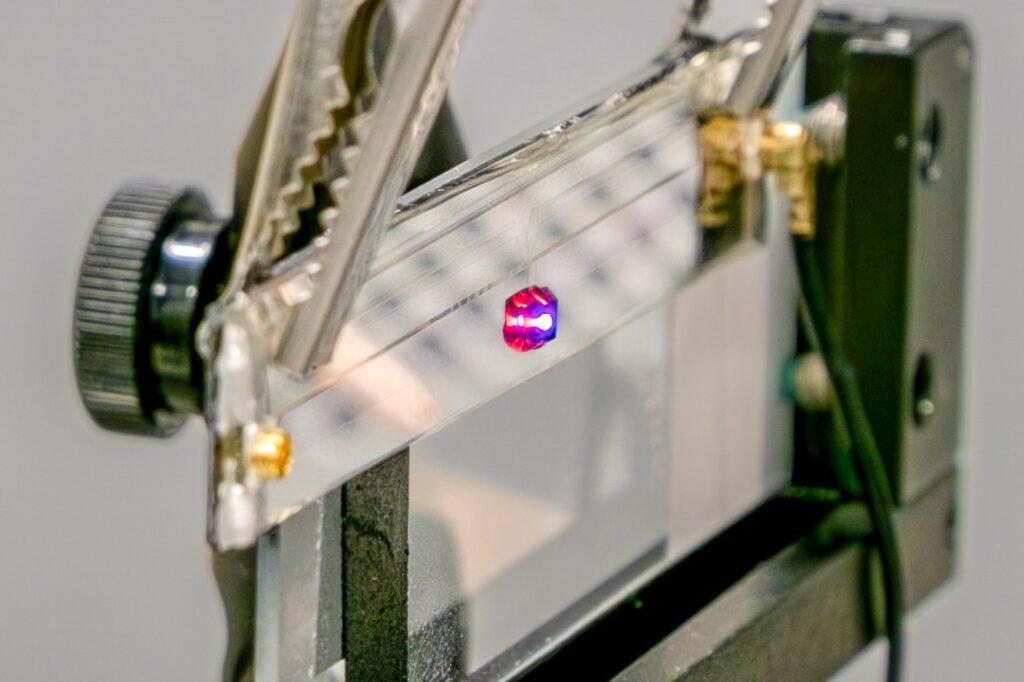
Fraunhofer IPMS and the Max Planck Institute for Chemical Physics of Solid States CPfS are introducing a new CMOS-integrated platform for quantum sensing. Patrick Engelmann, project leader at Fraunhofer IPMS, highlights the benefits of the new approach: “The newly developed CMOS-based platform for quantum sensing can be easily operated at room temperature due to NV technology, where otherwise complex cryotechnology would be required. By integrating the light source, detector, microwave, and readout on a chip, the system is significantly miniaturized and consumes very little energy. Furthermore, we can achieve spatial resolution in the micrometer range using multi-channel arrays instead of single measurement points. The system is robust and portable, as it does not require lasers or optics.”
The development of these CMOS-integrated quantum sensors opens new horizons in various fields, from geophysics for exploring deformations of the Earth’s magnetic field to medicine for heart and nerve monitoring, and potentially as an interface for brain-machine interaction. This technology addresses challenges that have not been resolved previously, such as portable magnetic field quantum sensors for rapid, highly sensitive on-site analyses and simplified laboratory workflows.
At Fraunhofer IPMS, the required CMOS backplane is designed and manufactured in a commercial semiconductor facility. Afterwards, OLED light sources will be integrated onto the chip at the institute. The precise alignment of the NV diamonds to the sensor pixels is crucial for optimal measurement results. The work builds on the available expertise at the institute for the integration and manufacturing of OLED-on-silicon devices, specifically based on the so-called “bi-directional” microdisplays with image capture and playback functionalities on a chip.
The MPI CPfS is engaged in the joint project with measurement methodology, as well as the investigation of quantum optical material in the form of NV diamonds and alternative materials for this application.
So far, the joint integration of OLED and antenna, as well as the excitation of the NV center in a technology demonstrator, has been demonstrated. Work is still ongoing on the complete CMOS integration of the sensor system, including photodetectors and the complete readout circuit. Initial industry partners have already expressed interest. Verification in initial research applications is expected within three to four years. Upon positive validation, the platform can be quickly adapted to specific applications and transitioned to pilot production.
