

Copenhagen – November 12, 2026
Predicting how molecules interact is central to drug discovery: it offers important information about how a new drug might work in the human body, the side effects it can cause, and more. Computationally modeling these interactions can reduce the need for lengthy and expensive lab work, but some interactions still remain beyond the reach of classical computers.
The Danish quantum software company Kvantify has taken a significant step toward overcoming this challenge by accurately capturing an interaction relevant to biomolecular stability using a novel computational model tested on Quantinuum’s System Model H2 quantum computer.
The study focuses on dispersion interactions. These interactions are individually small but collectively make a big difference in helping stabilize, for instance, biological structures such as DNA and proteins, as well as influencing how molecules bind to each other. Accurately describing these interactions is difficult because it involves predicting how electrons behave. Modeling this behavior requires enormous computational resources.
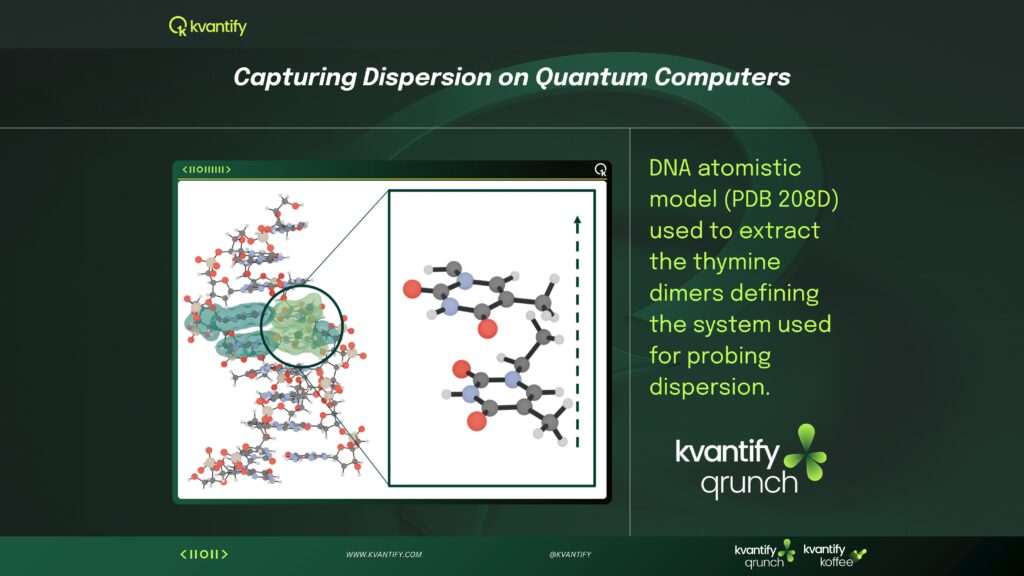
Using a pair of molecules derived from a DNA structure, Kvantify investigated how the interaction changes as the molecules move apart. The team applied its quantum algorithm, BEAST-VQE, combined with exact quantum circuit simulation through Qrunch’s optimized integration with NVIDIA cuTensorNet, and compared the results with the established quantum chemistry method CCSD(T).
Three key findings:
- More efficient calculations. Kvantify obtained results matching the accuracy of the CCSD(T) method while reducing the required count of active orbitals from 236 to only 53, thus making the calculation less computationally demanding.
- Consistency between simulation and hardware. The team ran calculations at two representative molecular geometries on Quantinuum’s System Model H2 quantum computer and produced results almost identical to ideal simulations. This supports the feasibility of studying this subtle interaction on current quantum devices.
- A step towards practical relevance for drug discovery. The problem of molecular stacking helps test novel computational methods on their way to becoming relevant in real-world quantum chemistry workflows related to molecular recognition and binding.
The result is a molecular benchmark, demonstrating how to test the accuracy of computational predictions rather than claiming commercial quantum advantage. The study uses a simplified model, with hardware calculations covering two geometries rather than the full interaction curve. However, it is significant because it shows the value of integrating quantum and classical methods when investigating molecular interactions – even with quantum computers that are available today.
The work also highlights the next developmental challenge: reducing classical computational bottlenecks as higher-quality quantum hardware becomes available.
About Kvantify
Kvantify is a Danish company established in 2022, developing hybrid quantum-classical software for real-world applications, e.g. in life science and drug discovery. The company has 45 employees.
Contact
David Siebert
SVP, Global Head of Business Development
ds@kvantify.dk
